I've recently discovered that the most dangerous thing about vibe coding isn't bugs — it's that I forget to use the bathroom.
That sounds a little absurd.
After all, I'm not doing extreme sports or on some mountain retreat.
I'm just sitting at my computer with Cursor, Codex, and ChatGPT open, vibe coding away, dragging prompts, articles, characters, and workflows out of my head and onto the screen.
But that's exactly the problem.
When AI is going too smoothly, it's easy to forget you still have a body.
A clear head, flying fingers, screens sprouting new content, tasks breaking apart one after another.
I start to feel like I'm in great shape — AI keeps generating, I keep catching, and I get so productive I stop feeling like a normal human.
Until I suddenly notice:
No water drunk. No bathroom break. Shoulders locked stiff.
My eyes are dry.
My body is like a small machine left running in the corner, quietly overheating.
Ugh. Human-AI collaboration requires self-management.
And not some sophisticated kind of management.
The very primitive kind.
---
1. 50 Minutes of Coding, 10 Minutes of Rest
It's a bit like a variant of the Pomodoro Technique.
But for me, it's not about boosting efficiency — it's about catching my breath.
Because vibe coding rarely has a natural stopping point.
Traditional work at least gets stuck sometimes — looking things up, fixing formatting, waiting for inspiration, cursing yourself for not being good enough.
But now AI just keeps catching the ball, and it gives instant feedback.
I throw in one line, it hands back ten. I open one file, it splits it into three modules for me. I say "trim it down more," and it actually trims it down more.
This is too dangerous.
You keep thinking:
"Just one more round." "Just one more tweak." "Just let it run once more." "Just turn this prompt into a skill and I'll stop."
Then two hours pass.
My body is still stuck back in hour one.
Awei in this mode may look like he's doing something sophisticated — vibe coding — but it's really not that different from scrolling short videos.
Both are addictions.
So my rule is simple and blunt:
When 50 minutes are up, stop.
Even if things are flowing.
Especially when things are flowing, that's exactly when to stop.
Because when things aren't going well, you naturally stop anyway. What actually sweeps you away is usually when things go too well.
---
2. During the 10-Minute Break, Only Three Things
Drink water. Use the bathroom. Breathe.
These three things sound pretty ridiculous.
Drinking water reminds the body: "I know I'm still here."
Using the bathroom is admitting that I'm not some pure digital being of uploaded consciousness — Awei's actual body is still a purely carbon-based lifeform.
Breathing is the hardest one.
Because during rest, it's easy to pretend I'm resting when really I've just switched to a different way of taking in input.
Scrolling my phone, checking messages, thinking up the next prompt, rehearsing the next architecture in my head.
It looks like I've stepped away from the computer, but inside, it's still running.
So the point of breathing is: do nothing at all.
No input. No organizing. No output.
Don't use it as a chance to plan the next step.
Just sit, and breathe.
The past — no clinging. Right here, right now, I breathe. The present thoughts — no worrying. Right here, right now, I breathe. The future — no anxiety. Right here, right now, I breathe.
It's not some grand spiritual slogan.
For me, it's just a few plain words telling my brain:
"Right now, no problems to solve. Right now, nothing to generate. Right now, no need to prove how great I am."
Doing nothing is actually when the better connections show up.
Not the kind of frenzied, high-volume output from an excited state, but something quieter, more refined, more like what I actually want to say.
The brain needs a little blank space before it can stitch together, on its own, the scattered pieces from before.
In neuroscience terms, this echoes the "default mode network" (DMN) — a group of brain regions typically tied to inner reflection, self-referential thought, memory, and imagining the future during rest, and whose activity tends to drop when we're deeply focused on an external task.
So I won't frame this as some magic guarantee that "breathing will definitely make the work better."
A more accurate way to put it:
When I stop chasing after AI's output, my brain gets a better chance to reorganize the recent material into something that's actually connected to me.
Especially since this Awei column runs on high-concentration AI writing — 99% of the text is AI-generated, with only 1% hand-checked by Awei.
If what gets created has nothing to do with me at all, it's no different from ordinary AI slop — low-quality AI content, basically kitchen scraps.
---
3. Write the Most Important Things Down with Pen and Paper
This one matters a lot to me.
Because AI is too fast.
So fast that often I start creating before I've even finished thinking something through.
The moment an idea appears, I want to throw it at ChatGPT. The moment a structure lights up, I want Codex to break it apart for me. The moment a title surfaces, I want it to generate three versions, five, ten.
The result: ideas seem to multiply, but my attention starts to scatter.
So now I force myself to pick up pen and paper.
Don't create yet.
Write it down first.
List out whatever comes to mind, messy is fine.
It could be a task, a sentence, a worry, an image that suddenly pops up.
Pen and paper have one advantage:
They're just genuinely slow.
I can't unfold everything instantly like copy-paste.
My hand has to move, the pen tip has to touch the paper, the letters come out a little crooked, and the speed is forced to slow down.
And that slowdown is precious.
It lets me feel again:
Which things are just excitement, and which really matter.
Once I've written it all out, I circle the three most important ones.
Only three.
Not everything gets done.
Not everything gets fed to AI.
Not every idea deserves to become a project right away.
Record first. Then narrow down. Then create.
This order has saved me from countless overexcited nights.
---
Finally, Back to the Desk
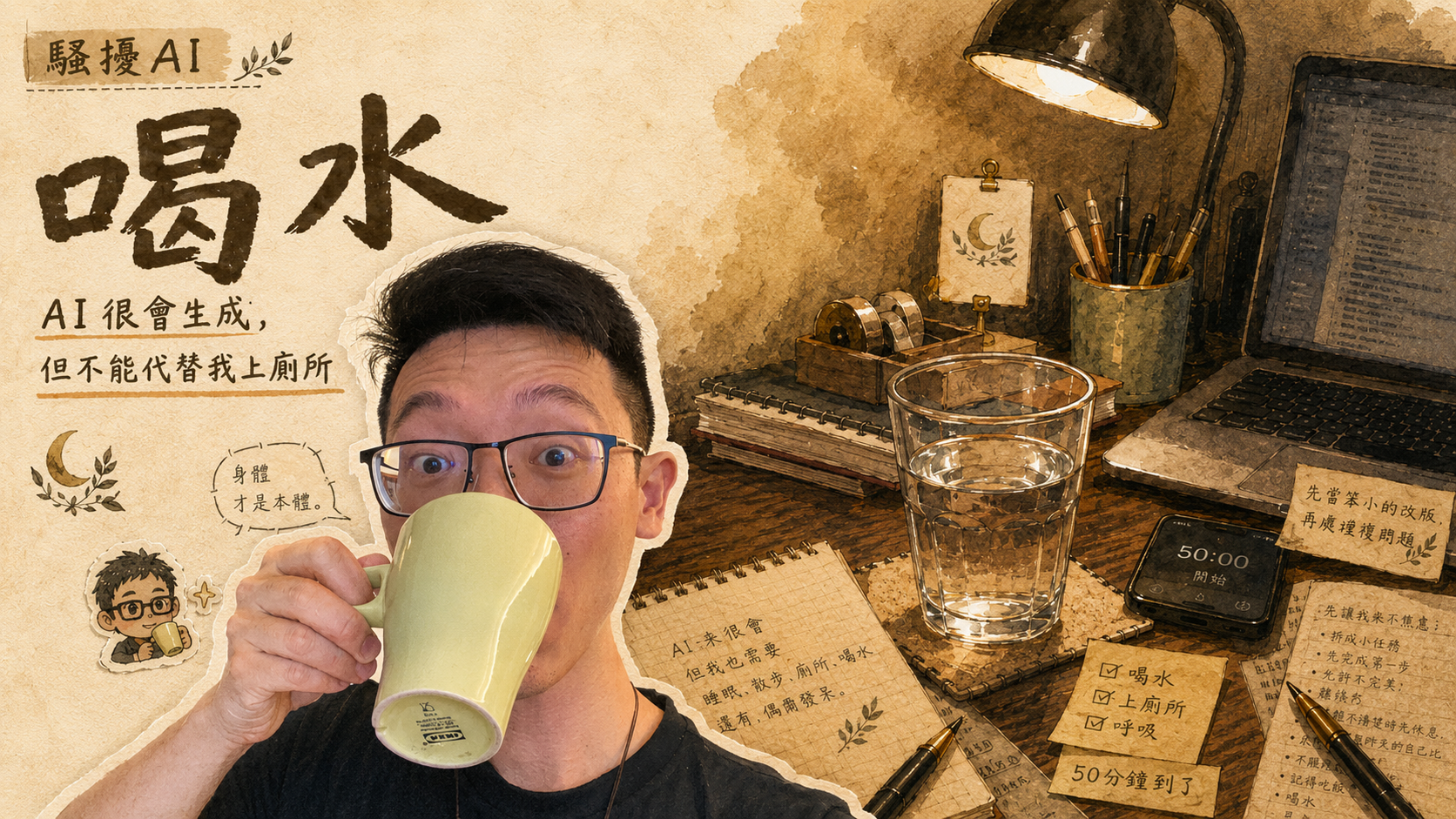
So lately my vibe coding desk has gained a few very low-tech items.
A glass of water. A pen. A pad of scrap paper. The built-in 50-minute timer on my iPhone.
Very ordinary.
So ordinary it barely looks like a human-AI collaboration workflow.
AI is great at generating.
But it can't drink water for me.
It can't go to the bathroom for me.
And it can't remember to breathe for me when I'm too high on the moment.
Hm... having written this far, I think it's about time I went and drank some water.
---
References
- Buckner, R. L., & DiNicola, L. M. "The brain's default network: updated anatomy, physiology and evolving insights." *Nature Reviews Neuroscience*, 2019.
#PesteringAI #AICreation #VibeCoding #HumanAICollaboration #SelfManagement #DrinkWater #Rest #PenAndPaper #DefaultModeNetwork #AIWorkflow