I'm hooked. Vibe coding, illustrated writing, novels, music remakes — all open at once. Ideas sprout like mushrooms after rain, popping out of the ground overnight, so many it's almost suspicious.
A-Huan is in there taking a walk, Qingmi too, and a dozen or so characters who haven't officially debuted yet are already lining up and knocking. This street won't settle for being just one short story either — it's grown into two seasons, twenty-six episodes' worth. Characters, relationship threads, foreshadowing, covers, character art, titles, worldbuilding — all marching forward in formation.
Meanwhile, Suno is still waiting for me to remake ten to twelve old demos. Each one feels like an old friend who hasn't gotten dressed again yet.
I'm so high on it!
But the body is honest.
After a shower and a change of clothes, there's still a stale smell. Like fatigue that's been stewing inside the body for too long, slowly seeping out through skin, scalp, collar, and breath.
It's not a loud smell, but it's an honest one.
"You've been a little tired lately."
---
These past few days I took my own state apart and reached a few small conclusions:
- Still smelling tired after a shower doesn't mean you didn't wash properly. Staying up late, stress, excitement, and sleep deprivation all affect the autonomic nervous system, sebum, sweat, and metabolism. The body isn't dirty — it's exhausted.
- The thrill of AI creation is a little like gacha pulls. Sometimes what comes out is terrible, sometimes it's average, and sometimes it's suddenly, shockingly on point. That hope of "the next version might be better" makes it very easy to keep clicking.
- Between flow and addiction runs a very thin line. Flow keeps you clear-headed, focused, and full of creative energy — but once it starts eating into sleep, your partner, breakfast, and recovery, it's time to be careful.
- AI was originally supposed to free up slack. If, after cutting costs and boosting efficiency, all I do is open more projects, push more versions, and stay up even later, then the time I saved never made it back into my life — it just got claimed by an even bigger creative hunger.
- The meaning of human-AI collaboration might not be so grand. For me, it might just be: being able to properly call my wife at night and listen to what she wants to say, and being able to slowly eat a plate of scrambled eggs in the morning.
---
Lately, I've gotten hooked on vibe coding, and on illustrated writing too.
"Hooked" might be too light a word. It's more like being carried off entirely. Cursor, Codex, ChatGPT, image generation, character design, cover layout, novel worldbuilding — all wired together like a workshop that refuses to turn its lights off at midnight.
I toss in a sentence, and structure grows out of it.
I toss in an image, and a cover grows out of it. I toss in a character, and it starts to get ears, clothes, lines — a little clumsy, but with an expression that reads as human.
This is way too captivating.
In the past, when inspiration struck, I had to write slowly, look things up slowly, and wait slowly until I had the energy. Now AI is like a crowd of little craftsmen — the moment I say, "go on, give it a try," they start hammering away.
Sometimes what they hammer out is absurd.
Sometimes it's ordinary. Sometimes it's suddenly, brilliantly inspired.
That's exactly where the danger lies.
You want to try once more, revise one more version, touch up one more image.
Make Awei's lines a little more clumsy. Make the cover title feel more like it grew out of the story. Upgrade the prompt again. Tidy up the worldbuilding a bit more.
Those days, I was clearly exhausted, but my expression felt unusually sharp. Sentences lined up and came out on their own; images lit up one after another. That kind of excitement is beautiful — beautiful enough that I nearly believed I really wasn't tired.
But the body didn't cooperate. It started to smell.
Not just sweat — more like fatigue that had been stewing too long, slowly seeping out from inside. Like a room during the plum rain season: the window's open, and the corners are still damp.
The body really is an honest thing.
The brain says: "I can still keep going."
The creative urge says: "Just a little more." The tool says: "The next version might be better." The body just says: "I'm tired."
One night, I noticed I'd started phoning it in on my nightly call with my wife.
She was talking, and I was responding, but I wasn't actually there.
She'd tell me what happened that day, and I'd go "mm-hm, uh-huh" while my mind was still on that last image, the title proportions, the character's build, whether the prompt could be trimmed further, whether I could start a new project tomorrow.
This is dangerous.
Because I know very well: if AI's involvement only makes me more productive, that's not actually something worth celebrating.
After cutting costs and boosting efficiency, where does the saved time go?
If it all goes into starting more tasks, time hasn't actually grown — work has just started reproducing.
If it all goes toward chasing higher output, life hasn't gotten any deeper — a person just turns into a small factory. If AI saved me from repetitive labor, and I spend that slack staying up even later, then the tool hasn't brought me back to my life — it's just delivered me into a prettier kind of burnout.
I still love creating.
I love it almost childishly. Like getting a new box of crayons as a kid and thinking you could color an entire wall. Like someone who hasn't played in ages, suddenly remembering they could still be happy this way.
That happiness is real.
But a person can't live on excitement alone.
"Excitement" tricks you into thinking you're in great shape.
"Output" tricks you into thinking you're making progress. "Clarity" tricks you into thinking you're doing well.
But sleep keeps a ledger. The body keeps a ledger. So do relationships. Lost sleep — it writes that down. A skipped breakfast — it writes that down. An absent-minded phone call — that too. Words that never got properly heard slowly settle into a relationship. Light at first, but given enough time, they start to smell. So these past few days, I've started going to bed a little earlier.
No grand declaration of self-discipline, no sudden transformation into a morning person. Just closing the laptop and telling myself:
"Time to sleep."
If it still matters tomorrow, it'll still be there.
So I slept eight hours.
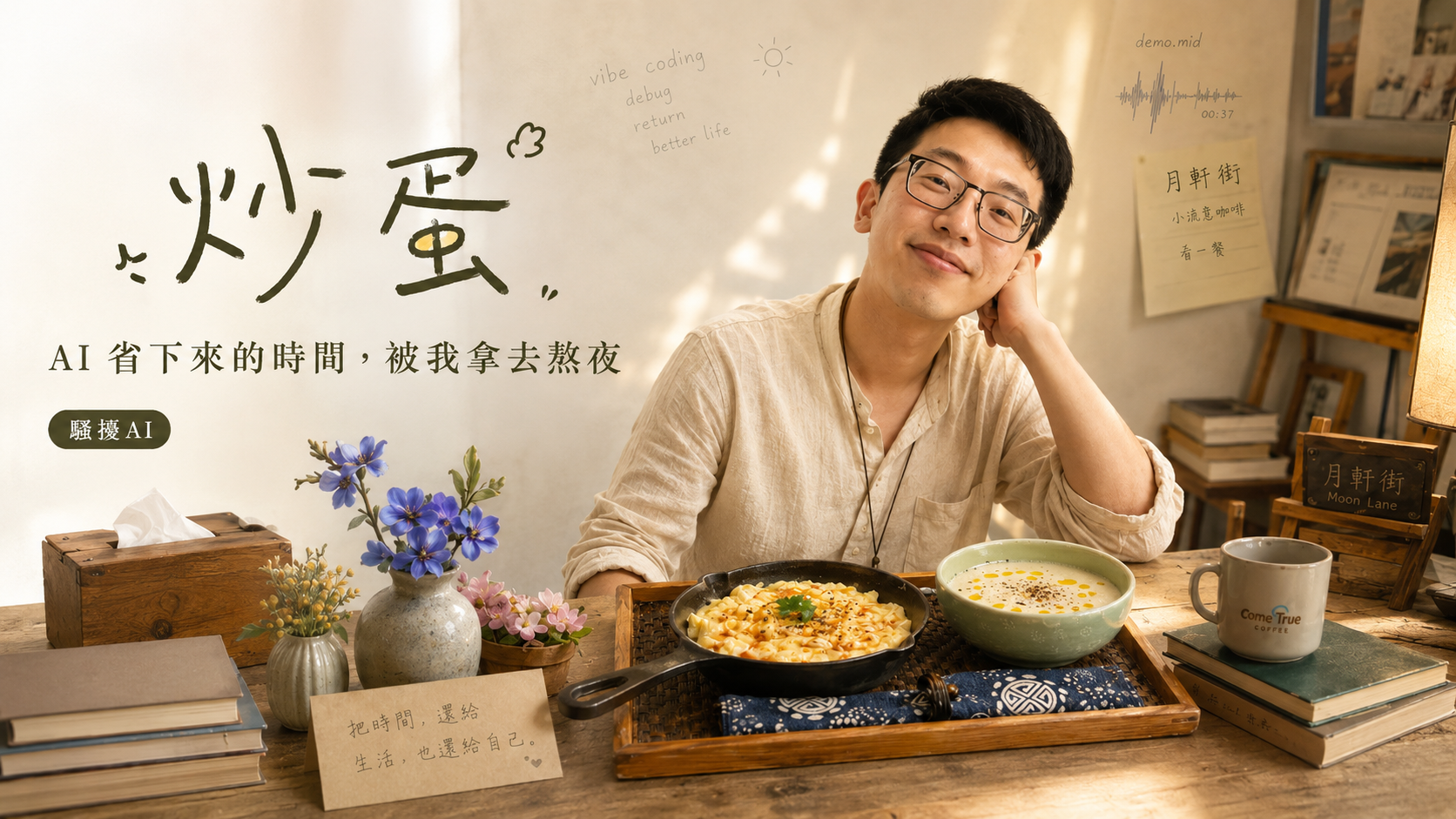
I woke up in the morning, washed my face, sat down to breakfast. In front of me was a plate of scrambled eggs, a bowl of hot soup beside it, a small flower on the table. The eggs were soft, the soup was hot, and the air didn't have that glowing, wired tension of the middle of the night.
The meaning of human-AI collaboration might really not be that complicated.
It's about handing off the repetitive, draining parts that a tool can take on, and then giving the slack you save back to your body, back to your relationships, back to your life.
You can go to bed a little earlier.
You can properly eat breakfast. You can listen all the way through what your wife says. You can be on a phone call without rushing back to your own universe. You can let creating go back to being something you love, instead of turning into another chase.
I'll keep writing.
I'll keep drawing too.
And needless to say, I'll probably keep on pestering AI over and over.
I just want to slowly remember: "However powerful the tool, it can't sleep for me. However good AI is at generating, it can't digest life for me. However beautiful the work, it can't listen to a person, really listen, for me."
---
Afterward, I looked at that plate of scrambled eggs.
Very ordinary.
Very hot. Very quiet.
No worldbuilding, no version number, no prompt — just a plate of scrambled eggs sitting on the table in the morning.
Maybe the endpoint of human-AI collaboration isn't necessarily a more complete workflow, or a factory of work built ever higher.
Maybe it's just one morning when I finally stop rushing after the next idea.
And slowly finish a plate of scrambled eggs.
Then, come evening, pick up the phone.
And bring my mind back.
Listen to the person on the other end.